

How to Photograph a Black Abaya So the Weave and Seams Still Show
Kate · Founder and Creative Director, BlueSky Studio
9 min readPrices checked
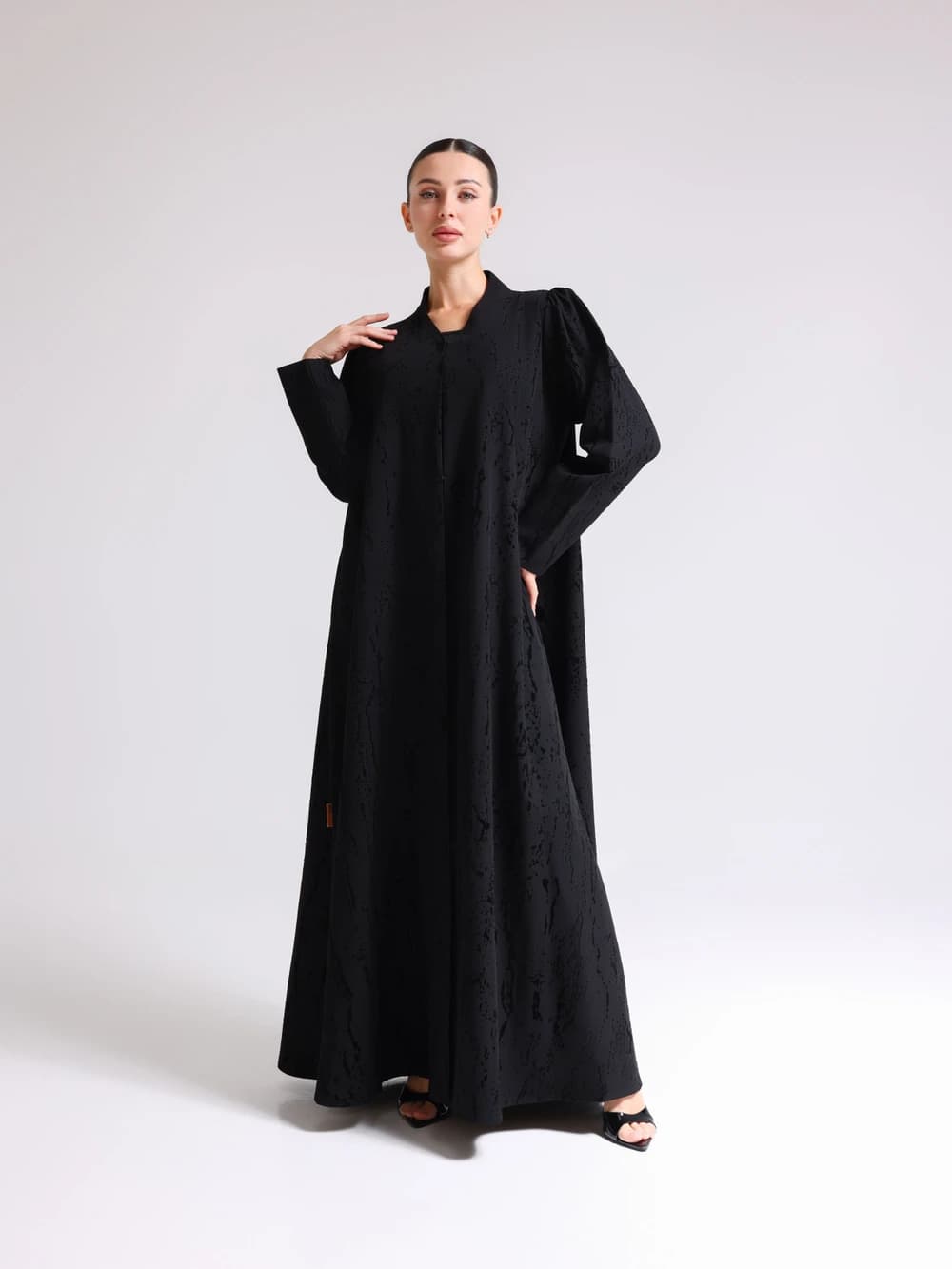
Black abaya photography comes down to three decisions: set the exposure by hand, because the camera's meter misreads black; light from angles that put a sheen on the weave; and edit the lower mid-tones while the deepest creases stay black. Do that and the seams, pleats and embroidery survive to the phone screen.
The basic set-up, side light plus an edge light behind the shoulder, is on the page for abaya photography in Dubai; this guide goes deeper. Shade accuracy has its own guide, for coloured and pastel abayas.
Why the camera's meter gets black wrong
A camera meter assumes the frame averages out to mid-grey. It cannot tell that the abaya is black, so it errs in a direction set by whatever else is in the frame.
| The frame | What the meter does | What you get |
|---|---|---|
| A black abaya filling the frame | Adds exposure to make it mid-grey | Charcoal fabric, burnt-out skin |
| A black abaya on white | Cuts exposure because of the white | A grey background, no seams |
| The model turning, flash on TTL | Changes the flash output every frame | Several blacks in one listing |
So set everything by hand: camera in manual, flash on manual power, ISO at its base setting. An incident meter held at the garment, dome towards the camera, measures the light falling on the abaya whatever its colour. Under continuous light, a spot reading off black fabric needs about two stops taken off. Lock the result for every black piece in the set-up.
Then check it tethered, since the camera's histogram comes from a JPEG preview: with the shadow clipping warning on, sample the fabric on the 0 to 255 scale. As a starting point, the lit surface of most black fabrics reads around 40 to 60, and the deepest fold the customer needs to see should stay above about 15.
Light angles and modifiers that show the weave
Black absorbs most of the light that reaches it, so the camera records it mostly as sheen: the light source reflected in the fibres. The size and position of the source decide where that sheen lands; power only changes the exposure. How each abaya fabric takes the light is a subject of its own.
For full-length frames, use the largest softbox in the kit. Its reflection spreads across the folds as long gradients, which is how the eye reads drape. A small hard source turns the same folds into bright streaks and black valleys, so keep raking light for the detail frames. Move the key until the sheen sits on the folds facing the lens.
The shadow side of black falls to pure black fast. A large white reflector close in keeps it within about a stop of the lit side. Then check every light from the camera position: any whose front you can see greys the blacks with flare, which a lens hood and a flag remove.
Light also falls off down a full-length abaya. With the key at shoulder height 1.5 metres from the model, the hem gets about a stop less light than the shoulders; at 3 metres, under half a stop. Use a bigger source to keep it soft at that distance, or aim an upright strip box at the hips.
Separating black fabric from the background
Four choices keep a black outline apart from the set.
- Distance. Close to the wall, the abaya's shadow lands on the wall and merges with its outline. Two to three metres out, where the zone allows, the background can be lit on its own.
- A pool behind the shoulders. Shoulder line, sleeves and shayla carry most of the silhouette, so aim a soft pool of light from a gridded head at the wall behind them. On a mid-tone surface such as the Desert Wall in the Sand room, it needs little power.
- An edge on the shayla. A black shayla over a black abaya merges head and shoulders. A small gridded light above and behind the model, touching only the edge of the shayla, draws the outline back.
- A visible hem. On a dark floor a black hem vanishes and the abaya looks shorter than it is. Choose a lighter floor, or skim a low light across it behind the model.
Black on black, and black on white
Black on black
The Concrete room's Dark Set, from AED 350 + VAT per hour, is a low-key zone where a black abaya makes a strong campaign frame. Keep all light off the wall until it sits darker than anything in the garment you need to show. Two edge lights, one behind each shoulder, outline both sleeves, and a narrow strip box in front runs sheen down the folds. A customer cannot judge a cut from a low-key frame, so shoot the listings on a lighter set.
Black on white
The Noon, Namshi and Amazon.ae image specs list pure white for an Amazon.ae main image and light grey as Noon's recommendation for fashion. On white, light the background on its own, about a stop above the garment. More than that flares back, eats into the black edge and greys the abaya, so keep the model two metres or more in front and flag the background lights.
An opaque abaya can also be shot on pale grey and cut out to white, since its edge masks cleanly. Sheer pieces belong on lit white: grey showing through chiffon has to be rebuilt by hand.
A lit-white set uses four heads: two on the background, a key and an edge light. Confirm the backgrounds and the number of flash heads with the room when you book.
Stones, beading, lace and metallic thread
Expose for the fabric. A crystal's glint can burn out to white, because that is what a sparkle is; pull the exposure down to hold it and the abaya around it sinks into black.
| Detail | What makes it read | What goes wrong |
|---|---|---|
| Crystals | A small hard source the lens sees reflected | Soft light alone turns them grey |
| Black beads | A hard source to one side | A polariser can strip the glints |
| Gold or silver thread | A broad source at the reflection angle | Off the angle, gold reads brown |
| Sequins | A large source for shimmer, a small one for sparkle | Mixed sources look speckled |
| Black lace | Something lighter behind it | Over black lining, the pattern vanishes |
Each stone fires only when the light, the stone and the lens line up, so shoot a short burst as the model settles and keep the frame where the cuff catches.
Shoot lace as worn, then add a detail frame lit from behind so the pattern reads.
The open abaya over a dress
A white dress reflects roughly thirty times as much light as black crepe, about five stops, before lighting adds any contrast. Keep the lighting ratio low and meter for the black. If the dress burns out, a small net or the edge of a flag between the key and the dress takes it down without touching the black.
With black, the dress also decides whether the opening reads. A black dress under a black open abaya hides the front edges, while a plain, matte dress a few tones lighter, in charcoal, stone or taupe, shows them and the trim. If the abaya is sold with a black dress, shoot the set as sold and add a frame with one front edge held open.
Retouching black without turning it grey
The shadows and blacks sliders lift the whole bottom of the range at once, so folds and creases flatten into charcoal. Use a curve instead. Pin the black point near zero and raise a point in the lower quarter slightly: the weave opens while the deepest creases stay black. Then, on a low-opacity layer, brighten the ridges of folds and seams that the light already touches.
Lifting the shadows also exposes colour noise, every pale speck of lint or foundation, and the undertone. Reduce colour noise first. On a neutral black, R, G and B sit within a few points of each other. Neutralise a lean that comes from the light, and keep one that comes from the dye.
For marketplaces, keep the deepest creases near true black, below about 10, with the texture just above, so the abaya reads as black on a thumbnail and as cloth when zoomed. Bring every black piece to one target value for the lit surface, export sRGB at high JPEG quality to avoid banding, and check the file on a phone at low brightness.
If the studio retouches, ask whether this tonal work and the clean-up are in the edit. Of the fashion and abaya production packages, Start (from AED 1,500 + VAT) lists a basic edit of cropping, colour correction and face retouch.
A shot plan for a black abaya day
Test every new set on the darkest piece in the collection before the first real frame.
| Block | Set | Light | Frames |
|---|---|---|---|
| Campaign | Sand Desert Wall or Heritage Arch Zone | Broad key, fill, wall pool, edge lights | Hero, movement, open abaya |
| Low-key | Concrete Dark Set | Two edge lights, a front strip | Campaign frames |
| Listings | White or pale grey | Key, fill, edge, background lights | The marketplace set per piece |
| Video | A set already lit | Aputure heads in the same places | Footage for abaya Reels |
| Details | A table, model released | Hard source, fill, macro lens | Weave, seams, stones, lace |
In the listing block, run the pieces from matte to glossy and plain to embellished, black before colour, so the light changes as rarely as possible. The frames per piece come from the nine-frame abaya shot list.
The Sand room is from AED 320 + VAT per hour, and Heritage and Concrete are from AED 350 + VAT per hour. Each booking includes every zone in the room, with Profoto flash and Aputure continuous lighting.
For an Eid collection, the studio's rule is to shoot eight to twelve weeks before Ramadan: for 2027, between 16 November and 14 December 2026, subject to moon sighting. The Eid production timeline sets the dates after that. Send the piece count on WhatsApp to +971 50 503 9936, noting which pieces are embellished, sheer or open. The studio in Al Quoz is open Monday to Sunday, 09:00 to 21:00.
Frequently asked questions
- Why do black clothes look grey in photos?
- Most often the camera's meter: it assumes the frame averages out to mid-grey and adds exposure, lifting black to charcoal. A bright background or an edge light shining into the lens lays a grey veil over the garment, and an edit that raises the black point does the same. Set the exposure by hand, flag lights away from the lens and lift only the lower mid-tones.
- Can you photograph a black abaya on a white background?
- Yes, and most marketplace main images need it. Light the background separately, about a stop above the garment, and keep the model at least two metres in front so the white does not wrap around the black edge. An opaque abaya can also be shot on pale grey and cut out to white, while sheer chiffon layers are easier on a lit white background.
- How do you photograph crystals and embroidery on a black abaya?
- Give the stones a small hard light whose reflection the lens can see, and keep a broad soft source on the fabric around them. Expose for the fabric and let the glints burn out, since a sparkle is a point of pure white. Shoot a short burst as the model settles, because each stone fires at one angle only.
- How do you edit black clothing without it turning grey?
- Keep the black point where it is and lift only the lower mid-tones with a curve, so the weave opens up while the deepest creases stay black. Brighten the ridges of folds and seams on a separate layer, reduce the colour noise that lifted shadows reveal, and check the export on a phone at low brightness, where crushed folds disappear first.
Written by
Kate
Founder and Creative Director, BlueSky Studio
Kate founded BlueSky Studio, registered the company and opened the Al Quoz Industrial Area 3 location, and designed the six permanent sets the studio shoots in. She sets the rates quoted in these guides and works on the floor with the teams who book them, so the timings, the equipment and the numbers here come from the rooms rather than from a content brief.
Keep reading
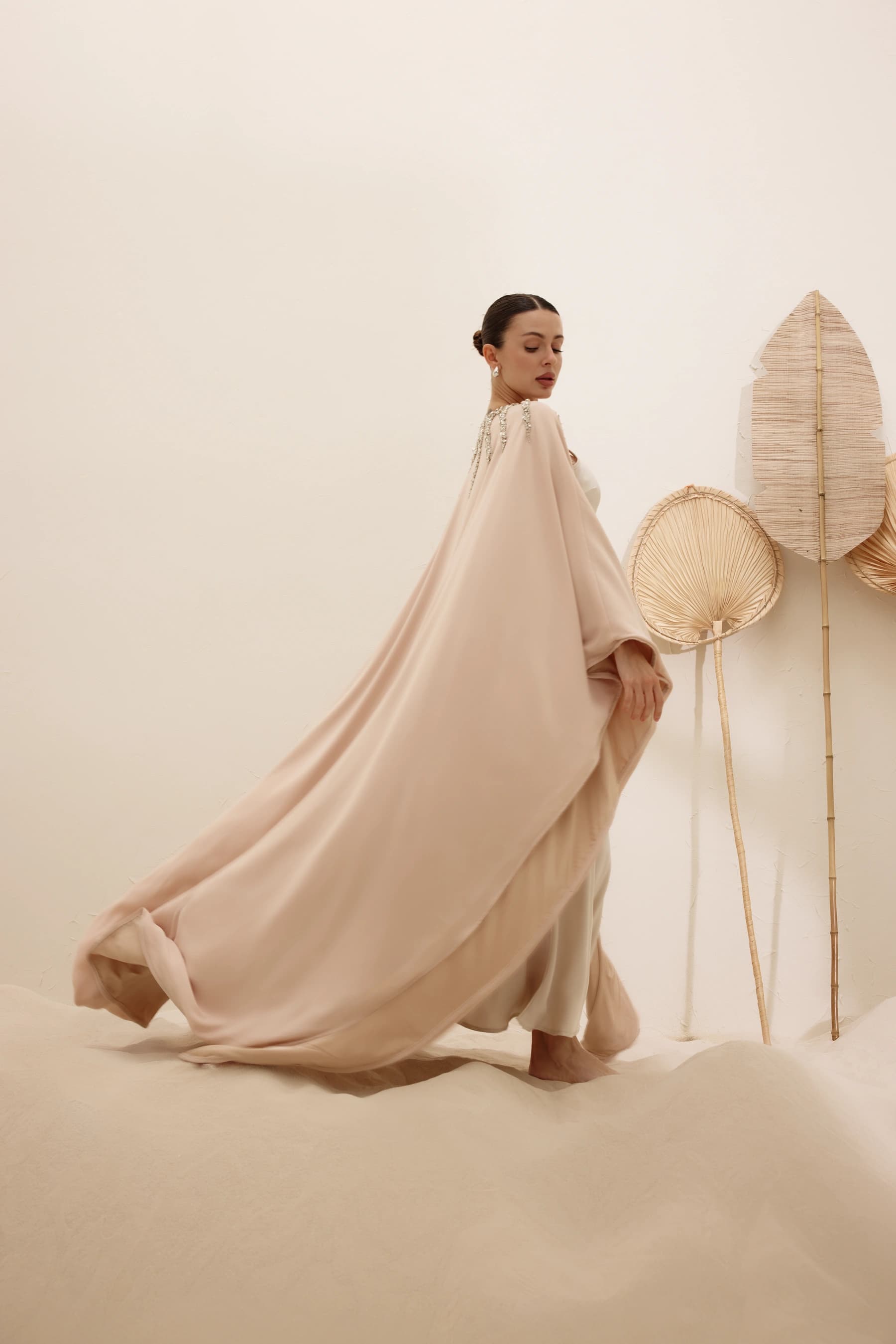
Beyond Black: Shooting Coloured and Pastel Abaya Collections
In coloured abaya photography, the shade on screen has to match the garment in the box. Grey cards, steady flash, the right wall and retouching to the card.
· 7 min read
How Many Photos Does One Abaya Listing Actually Need?
The nine frames an abaya shot list needs, realistic minutes per SKU, and worked examples at 15, 40 and 100 pieces so you can size the shoot before you book it.
· 14 min read
A Modest Fashion Glossary for Brands Briefing a Shoot
Abaya, jalabiya, kaftan, kandora, shayla, hijab, niqab and bisht defined for brands briefing a photoshoot, plus fabrics, cuts and why the right word matters.
· 13 min read
Six themed rooms in Al Quoz, lighting included, from AED 320 + VAT per hour.