

How Many Photos Does One Abaya Listing Actually Need?
Kate · Founder and Creative Director, BlueSky Studio
14 min readPrices checked
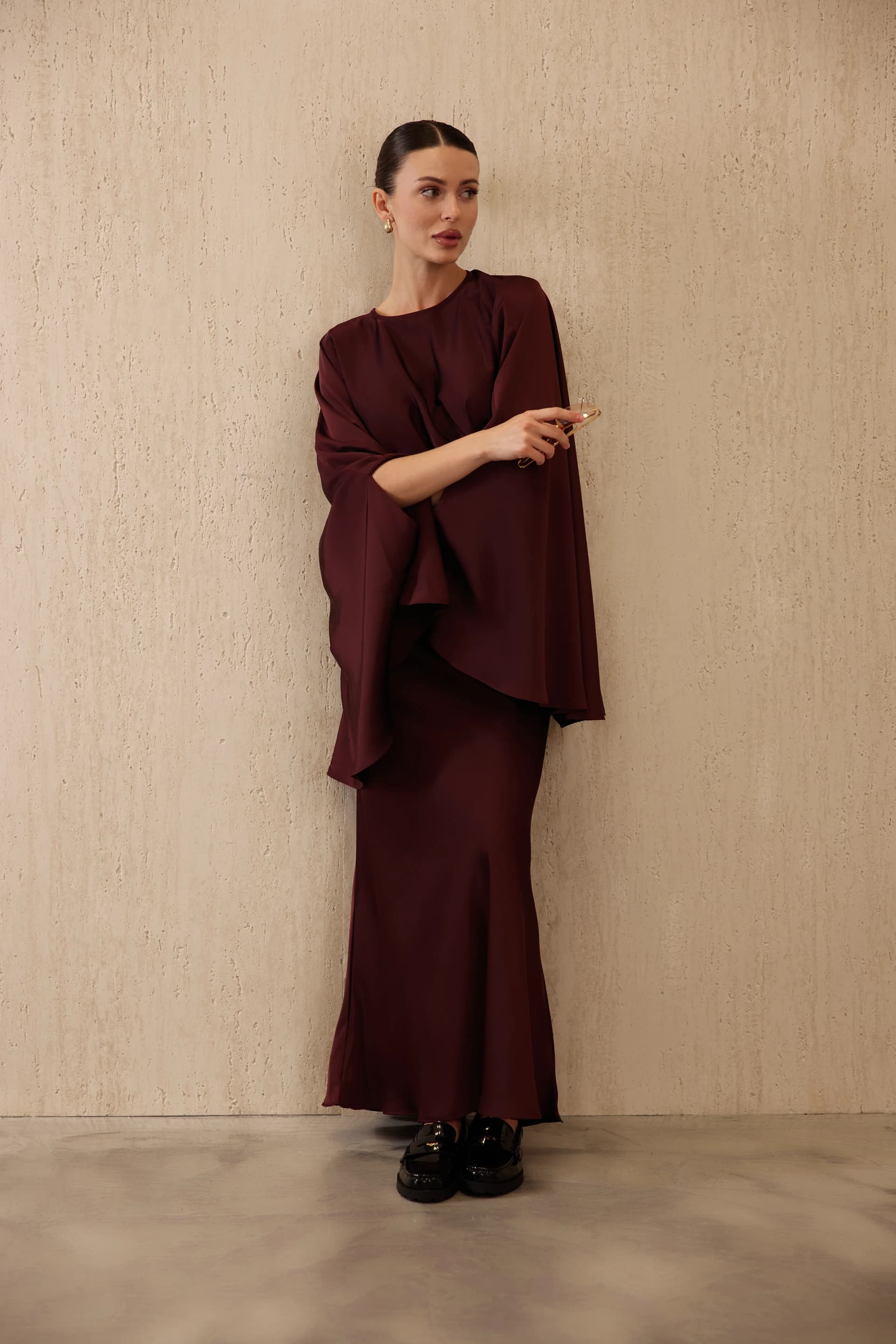
A lot of abaya listings stop at three shots: front, back and one close-up. That is enough to prove the product exists. It is not always enough to help somebody decide whether to buy it. How wide is the sleeve? How does the fabric fall when the model moves? Is the front open, magnetic or buttoned? How long does it look on somebody of a known height? Is the embroidery raised or flat?
Those are exactly the questions customers end up asking after looking at the listing. A useful abaya shot list should answer them before the customer has to send a DM. Below is the nine-frame set we would use as a starting point for one complete abaya listing, followed by realistic production timing and examples for collections of 15, 40 and 100 pieces.
For the broader lighting and room setup, see abaya photography in a Dubai studio.
The nine frames an abaya listing needs
You do not necessarily need nine completely different creative concepts. Most of the list is practical product information. Once the model, garment and lighting are ready, several of these frames can be captured in the same sequence.
1. Hero front
Full length, straight on. This is usually the image that becomes the marketplace hero, collection-grid thumbnail or first Shopify frame. Keep the garment centred and leave enough space around it for platform-specific crops. The hem should be visible, the sleeves should hang naturally and the fabric should not bunch around the feet.
If the same files are going to marketplaces, check the image specs for Noon, Namshi and Amazon.ae before the shoot rather than after retouching. The exact crop can change by platform, so shooting slightly wider than the final frame gives the retoucher more room.
2. Three-quarter view
The three-quarter frame shows the silhouette better than a straight front image. That matters with farasha, butterfly sleeves and other wider cuts. Two black abayas can look almost identical from the front and completely different once the model turns. If terms such as farasha, open abaya or butterfly sleeve are being used in the product copy, the modest fashion glossary is useful for keeping the shoot brief and the listing language consistent.
3. Back view
The back should not be treated as optional. Show the shoulder construction, yoke, seams, back embroidery, pleats or slit if there is one. A clean back frame also tells the customer whether decorative work continues around the garment or stops at the front.
4. Sleeve and cuff
Move in closer. Show the sleeve opening and any detail around the cuff. If there is elastic, a tie, button, embroidery, crystal work or a particularly wide sleeve, this frame often explains more than another full-length photograph. A sleeve that looks dramatic when the model moves can disappear completely in a static front view.
5. Front closure
Open abaya, hidden press studs, magnets, zip, tie or no closure at all — show it. This is a small frame that prevents a very common pre-purchase question. For an open abaya, it also helps the customer understand how much of the inner outfit will remain visible.
6. Embroidery or surface detail
Embroidery needs its own photograph if it is part of the value of the garment. Do not light it completely flat. A more angled source lets raised thread, crystals, beadwork or metallic details produce small shadows and highlights, so the customer can see the texture rather than just the pattern.
For black garments especially, lighting direction matters more than simply adding more light.
7. Fabric in hand
A fabric close-up tells the customer what a normal catalogue frame cannot. Gather the material lightly in the hand, let it fall and show how much structure or movement it has. Nida, crepe, chiffon and silk blends can look surprisingly similar in a static product photograph.
Once the fabric is held or allowed to move, the difference becomes much easier to read.
8. Scale and length
The cleanest version is an on-model full-length frame with the model's height included in the product information. It gives the buyer a reference for where the hem sits and how much volume the garment has on a real body. If there is no model, show the garment uninterrupted on a hanger or mannequin and make sure the full length is visible.
9. One movement frame
Finish with one frame that shows the garment doing what it does when somebody wears it. A step forward. A turn. A sleeve lifting. The hem moving. This can become a secondary marketplace image, Shopify lifestyle frame, social post or campaign asset without requiring an entirely separate setup.
It should still be photographed in the same session so the garment colour matches the catalogue images.
Black abayas need one extra consideration
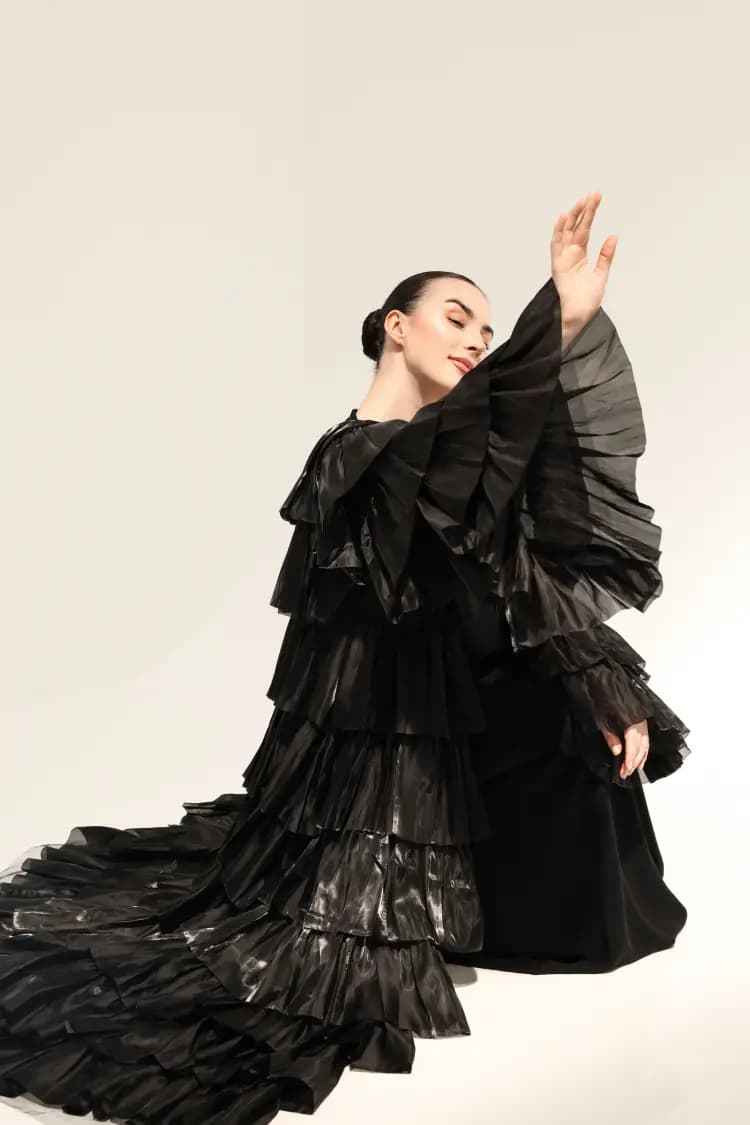
Black on black is where otherwise good catalogue photography starts losing information. A black abaya photographed frontally against a dark wall can become one shape with no visible seam, pleat or sleeve edge. BlueSky's abaya workflow uses side or raking light to bring the fabric texture back, with separation at the shoulder where necessary. The studio specifically recommends warmer mid-tone sets such as Sand and Heritage when a black garment needs more visual separation.
The product is still black. The point is simply to show that there is structure inside the black.
How long does one abaya actually take?
There is no useful single “minutes per SKU” number without saying what type of frames are required. BlueSky works with two benchmarks. For straightforward packshot-only clothing, around 40–60 items can be photographed in four to six hours when little styling changes between products. For a styled abaya or fashion lookbook, the pace is much slower: roughly two looks per hour once changes, pinning and re-steaming are included. Hair and makeup normally takes another 45–60 minutes before the first frame, while the initial light takes about 25 minutes to build.
That gives you the useful planning range. A simple packshot may move through the set in a few minutes. A fully styled abaya with model, scale frame, movement, fabric handling and detail corrections can easily use 20–30 minutes of production time per distinct style. The nine-frame set sits somewhere between the two depending on how you batch the day.
The faster way is not to shoot frames 1–9 for Abaya A, then frames 1–9 for Abaya B. Batch similar work together. Shoot the clean catalogue frames under one locked setup. Then shoot the details. Then run the on-model and movement block. That way you are not rebuilding the light nine times per garment.
Where the time goes
The camera is rarely the slow part. The time disappears between frames. The previous abaya comes off. The next one goes on. A fold from the garment bag needs steaming. A cuff needs straightening. The shayla needs re-pinning. The hem needs to be centred. The SKU has to be logged correctly before the next garment appears.
BlueSky recommends getting garments to the studio the day before wherever possible because steaming a full rail during the booking takes time away from photography. A steamer and lint roller are available in every room. Start and All-In Fashion & Abaya packages explicitly include a steaming assistant. Styling is also bookable through the studio when a collection needs more hands on set.
Model or ghost mannequin?
You do not need the model for every frame. A model earns their time on the hero, three-quarter, scale and movement frames because those photographs explain fit and drape. Product details can often be handled separately. For an open abaya, a ghost mannequin is particularly useful because it shows the shoulder shape and inner construction without leaving the mannequin itself visible.
BlueSky offers ghost mannequin photography for e-commerce and specifically uses ghost mannequin composites for open abayas. The process adds two extra frames per style plus a retouching pass. Confirm the ghost-mannequin cost with the studio when you book, so it is included in the quote before the shoot rather than added halfway through the day.
For larger catalogue jobs, see the BlueSky e-commerce production workflow as well.
Which room works best?
Three BlueSky rooms are particularly useful for abaya.
Heritage — from AED 350 + VAT per hour
Heritage has the Arch Zone, Lantern Corner, Carpet Area and Traditional Niche. It is the strongest fit for traditional collections, Ramadan and Eid campaigns, kandora and abaya work. The warm surfaces give black fabric something to separate against, while the architecture already gives the campaign a cultural setting without building a set from scratch.
Sand — from AED 320 + VAT per hour
Sand is less traditional and more editorial. Its Desert Wall and Earth Tones Corner give black garments a warm mid-tone background, while the simpler sets keep attention on the clothing. It is a good option when the collection should feel modest and warm without looking specifically Ramadan-themed.
Lobby — from AED 500 + VAT per hour
The room has a large open floor, natural light, floor-to-ceiling mirrors, curtains and plants, and is designed for movement, larger groups and shoots that need more physical space.
That makes it useful for the final movement frames, larger campaign shots or anything where the model needs room to walk and turn. See the Lobby. A room rental gives you access to all zones, together with the included professional lighting and grip.
15 abayas: one focused production day
Fifteen distinct styles means a theoretical maximum of 135 finished frames if every piece receives the complete nine-frame set. That does not mean somebody presses the shutter 135 times and the job is over. The efficient way is to split the day. Start with the clean catalogue and detail frames while the lighting is locked.
Then run the model through the hero, three-quarter, scale and movement frames in a separate block. For a collection this size, one properly prepared full day is a realistic starting point if the styling is consistent, samples arrive ready and there are no complicated lighting changes.
If every style needs different hair, accessories or creative direction, allow more. For production packages, the current Fashion & Abaya tiers place 10–20 pieces in All-In and 15–20 pieces in Kate's Package, so a 15-piece collection sits naturally inside those collection sizes.
40 abayas: separate catalogue work from campaign work
Forty pieces produce 360 potential frames at nine images each. This is where treating every image as one long shot list becomes inefficient. BlueSky's packshot benchmark is 40–60 clothing items in four to six hours, so a clean catalogue block for forty prepared garments can fit inside a day.
A complete nine-frame set with model, movement and individual detail work is a larger job. The practical approach is to separate catalogue frames from on-model and lifestyle frames.
If part of the collection consists of colour variants of exactly the same cut, you may not need to repeat every construction detail. A new colour still needs its own hero, three-quarter and fabric frame so the colour and drape are honest.
But if the cuff, closure and embroidery are genuinely identical, repeating every macro may add very little. The largest Fashion & Abaya package, Golden, is designed for 20–25 pieces over 3–4 hours, so forty pieces already go beyond it. Its deliverables are 90 edited photos plus video content — not nine finished listing images for every garment.
So do not read “20–25 pieces” as “225 finished product photographs included”. Package capacity and a nine-frame e-commerce shot list are two different things.
100 abayas: build a catalogue workflow, not a long photoshoot
At 100 pieces, the arithmetic becomes 900 potential frames. Nobody should be improvising garment order at that volume. Before the first day, split the collection into:
- distinct cuts
- repeat colourways
- open vs closed
- special embroidery / detail requirements
- model vs mannequin frames
Then build a fixed capture sequence and keep it unchanged. BlueSky's general e-commerce service offers bulk pricing for 100+ SKUs, which is the more appropriate starting point for a collection this size. The studio's packshot throughput is 40–60 items in four to six hours, while on-model work takes considerably longer because fitting and styling become the bottleneck.
For 100 pieces, plan the packshot work in production blocks and schedule the on-model frames separately. If many products are repeat colourways, the total can come down considerably. If all 100 are different cuts and every garment genuinely requires all nine frames, this is not a two-hour or half-day shoot.
It needs a catalogue production plan.
BlueSky Fashion & Abaya packages
The current fashion and abaya production packages are:
Start — from AED 1,500 + VAT
1 hour · 5–10 pieces
Includes a studio photographer, studio or outdoor setup, 30 edited photos, model with basic hair and makeup, 3 reels, one complimentary revision and a steaming assistant.
All-In — from AED 2,500 + VAT
2 hours · 10–20 pieces
Includes the studio photographer, 60 edited photos, 6 reels, model with basic hair and makeup, one revision and a steaming assistant.
Kate's Package — from AED 3,500 + VAT
2 hours · 15–20 pieces
Includes main photographer and videographer, two rooms, model with basic hair and makeup, 60 edited photos, 3–5 trend-led reels, one reel per piece, BTS content, iPhone content, raw files and a consultation.
Golden — from AED 5,900 + VAT
3–4 hours · 20–25 pieces
Includes photographer and videographer, access to all rooms for the production, model with basic hair and makeup, 90 edited photos, reels, one reel per piece, BTS, iPhone content, raw files and preparation/consultation time. Raw files are delivered the same day where included, with edited files delivered in 3–4 days.
These package piece counts describe what each production tier is designed to handle. They do not automatically mean every piece receives all nine images from this article. If you need the full nine-frame e-commerce set for every SKU, send that requirement with the collection count so the quote can be built around the actual number of deliverables.
Is a stylist included?
Not automatically in every package. Casting, styling and makeup are all bookable through BlueSky. Start and All-In explicitly include a steaming assistant, while the larger packages add more photography, video and creative-production deliverables. If the collection needs someone continuously dressing the model, pinning samples, adjusting the shayla or managing two rails, ask for a stylist or fitting assistant in the quote.
That person often saves more shooting time than a second camera.
What should be on site before you start?
A steamer and lint roller are available in the studio, but samples should still arrive as prepared as possible. Bring garments organised by SKU rather than loose in bags. For high-volume days, keep them in shooting order. If a dedicated clothing rail or mannequin is essential to your exact workflow, confirm it with the studio before arrival rather than assuming it is part of every room rental.
Ghost mannequin production itself is available and can be included in the shoot brief.
What to cut if the day starts running late
Do not make this decision at 18:45. Decide your priority before the shoot. If you have to reduce the abaya shot list, keep:
- hero front
- three-quarter
- closure
- fabric/detail
Those four answer the biggest product questions. The lifestyle movement frame is easier to sacrifice because it is not usually needed to prove construction. A second embroidery macro can go next if the main detail frame already shows the important work. I would keep the back and sleeve whenever possible, especially if either contains design features that are not visible from the front.
And do not leave the closure until the end. It takes seconds while the sample is in the room. Recreating that photograph after the garment has gone back to the warehouse can take an entire courier round trip.
Frequently asked questions
- How many photos does an abaya product listing need?
- A strong full listing can use nine frames: hero front, three-quarter, back, sleeve and cuff, closure, embroidery or surface detail, fabric in hand, scale and one movement frame. You do not necessarily need nine unique images for every repeat colourway if the construction is identical.
- How long does it take to photograph one abaya?
- For straightforward packshot-only clothing, BlueSky's throughput is around 40–60 items in four to six hours. For styled abaya and fashion work, the studio works at roughly two looks an hour once garment changes, pinning and steaming are counted. A full nine-frame listing therefore needs more time than a single marketplace packshot.
- Do you need a model for abaya product photography?
- Not for every image. A model is most useful for fit, scale, drape and movement. Clean product details can be photographed separately, while ghost mannequin works particularly well for open abayas and structured garments. BlueSky offers on-model, flat lay and ghost mannequin e-commerce photography.
- Does BlueSky offer ghost mannequin photography?
- Yes. For open abayas, BlueSky uses ghost mannequin composites to show the inner lining and shoulder structure without leaving the mannequin visible. The technique requires two additional frames per style plus a retouching pass.
- How many abayas can you shoot in one day?
- It depends on the shot list. Packshot-only days move much faster, with a benchmark of 40–60 clothing items in four to six hours. A styled lookbook runs closer to two looks per hour once garment changes and preparation are included. So send both the SKU count and the number of required frames per SKU rather than asking for a day based only on the number of pieces.
- Which BlueSky package fits 15 abayas?
- The current All-In package covers 10–20 pieces, while Kate's Package is structured for 15–20 pieces. Which one makes sense depends on whether the job needs straightforward photography or additional video, rooms and content deliverables.
- Which package fits 40 abayas?
- No single Fashion & Abaya package is built for 40 pieces: the largest, Golden, is designed for 20–25 pieces and includes 90 edited photos plus video and other content. If the requirement is nine final listing images for each of 40 SKUs, request a custom e-commerce quote rather than assuming all 360 images sit inside a package.
- Which room is best for abaya photography?
- Heritage works well for traditional, Ramadan and Eid concepts. Sand gives a cleaner warm editorial background and is useful for black garments. Lobby is the open-space option for movement and larger setups. Current rental prices are from AED 350 + VAT/hour for Heritage, from AED 320 + VAT/hour for Sand and from AED 500 + VAT/hour for Lobby.
Written by
Kate
Founder and Creative Director, BlueSky Studio
Kate founded BlueSky Studio, registered the company and opened the Al Quoz Industrial Area 3 location, and designed the six permanent sets the studio shoots in. She sets the rates quoted in these guides and works on the floor with the teams who book them, so the timings, the equipment and the numbers here come from the rooms rather than from a content brief.
Keep reading
A Modest Fashion Glossary for Brands Briefing a Shoot
Abaya, jalabiya, kaftan, kandora, shayla, hijab, niqab and bisht defined for brands briefing a photoshoot, plus fabrics, cuts and why the right word matters.
· 13 min read
Parking, Loading and Getting Your Kit Into an Al Quoz Studio
Parking in Al Quoz Industrial Area 3, where vans unload, and how to get rails, boxes and furniture in without losing an hour of your booking.
· 10 min read
Arabic, English or Both: What Works on Instagram in the UAE
Arabic or English content on Instagram in the UAE: who you write for, bilingual captions or separate posts, and why Arabic is written, not translated.
· 6 min read
Six themed rooms in Al Quoz, lighting included, from AED 320 + VAT per hour.