

What Is a Cyclorama, and Does Your Shoot Actually Need One?
Kate · Founder and Creative Director, BlueSky Studio
7 min readPrices checked
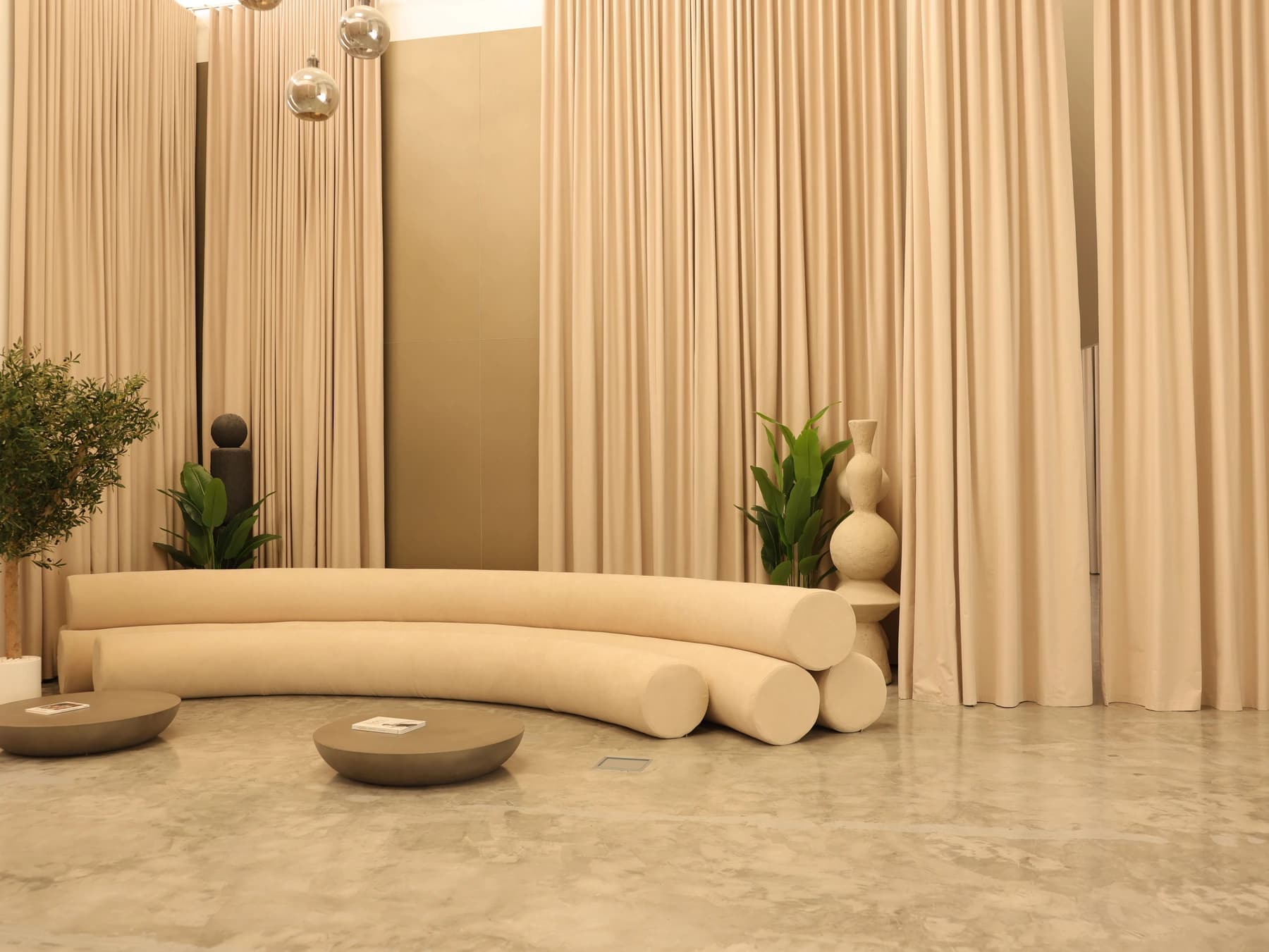
A cyclorama is a studio wall that curves into the floor in a smooth radius, so no corner line appears in the frame and the background reads as endless space. It is usually painted white. You will also see it called a cyc, a cyc wall, an infinity wall or an infinity cove.
A cyc is built for one job, isolating a subject in what looks like infinite space. Some shoots need exactly that. Most brand shoots do not, and for them a cyc adds lighting, retouching and styling costs without adding anything to the picture. The five questions further down tell you which kind of shoot you have.
How a cyclorama is built
Physically, a cyc is building work. A curved section, made from timber and plaster or bought as prefabricated panels, fills the joint between wall and floor, and the whole surface is painted one matt colour. Some studios curve two walls into the floor at once. That two-sided cove lets the photographer swing the camera through the corner without finding an edge.
White is the default because light alone can take it anywhere from pure white to mid grey. Green cycs exist for video that will be keyed, and a few studios paint one black for low-key work.
The floor is where a cyc wears. Models, crew and stands cross it all day, rubber soles leave marks, and studios that run one repaint it often, some between bookings. Expect a shoes-off rule or shoe covers on the painted area.
The curve itself is permanent. It cannot be moved, widened or folded away, and its size decides how wide and how tall a clean frame can be. A studio either has one or it does not, so the studios that do tend to lead with it.
What a cyclorama does well
Movement that leaves the floor. A dancer mid-jump needs wall and floor to read as one surface. Against a square corner, the join runs behind the feet and cuts the frame in two. On a cyc there is no line, so the jump reads as height.
Groups. Six dancers in a row with their arms out are wider than a 2.72-metre paper roll, the common wide size, so a full-length frame of all six shows the roll's edges. A wide cyc takes the whole troupe and leaves room to move.
Cars and large product. A car, a sofa or a run of shop shelving needs a curve far bigger than any roll of paper. Car studios build their cycs for this.
Video with a replaced background. A green cyc gives one even colour from floor to wall, so the keyer can pull a clean matte right down to the shoes. A white or grey cyc can be graded to any flat colour afterwards, which suits a brand film that wants its background in the brand colour.
Cutouts at volume. Three hundred catalogue frames that all need clipping go faster when every edge sits against flat, bright white. The retoucher masks against one even tone instead of a textured wall, frame after frame.
What a cyc costs you
The first cost is light. Cyc wall photography is lit in two layers, the wall and then the subject, and white only reads as white when the wall gets its own light, a little brighter than the subject's. That usually means two dedicated background lights before anyone has lit the model. Push them too far and the white bounces back as flare, softening edges and flattening contrast.
Every footprint, stand mark and scuff on the floor curve shows in a full-length frame. Each one is painted out before the shoot or retouched out after it, and both take time someone pays for.
Wide frames add a third problem. Light drops off towards the sides of the wall, so the corners of a wide frame go grey unless more lights are added. People budget for the frame they picture, and the frame they picture is usually the narrow one.
The largest cost is the empty space. A white void tells the viewer nothing about the brand, so wardrobe, props, hair and casting carry the message, and those lines of the budget grow. Plan them before the lighting, or hand the job over: full production packages cover concept, crew, shoot and retouching in house.
Cyclorama vs backdrop vs themed set
| Cyclorama | Paper backdrop | Themed set | |
|---|---|---|---|
| Look | Endless plain space | Plain colour behind one subject | A dressed room |
| Best use | Movement, groups, cars, keying | Headshots, packshots, single looks | Lifestyle, fashion, campaigns |
| Setup time | Long: light the wall first | Short: pull down the roll | Short: the set is built |
| Lighting demand | High: two or more background lights | Moderate: one background light | Moderate: light the subject |
| Retouch load | Scuffs, footprints, grey edges | Creases, roll edges | Mostly skin and garments |
| Cost impact | Extra lights, styling time | Lowest; paper is consumable | Set dressing already done |
Paper is the cheap stand-in for a cyc: one roll on two stands, curving onto the floor where it lands, good for one subject at a time. A themed set does a different job, because there the background is meant to be seen. Choosing between a paper backdrop and a themed set comes down to whether the background should disappear or carry part of the story.
Do you need a cyclorama? A five-question check
Answer yes or no for the shoot on your calendar.
- Does the subject leave the floor, in jumps, dance or a veil thrown mid-turn?
- Do you need clean cutouts at volume, dozens or hundreds of frames clipped to one background?
- Will the background be replaced or keyed in post?
- Are you shooting more than four people in one frame?
- Is the deliverable a flat-colour e-commerce frame, such as the pure white main image Amazon requires?
Three or more yes answers: book an infinity wall studio. A themed room would have you fighting the background in every frame, and the retouching invoice would show it. Before you book, ask for the usable width, the height of the curve and how many background lights come with the hire. A cyc too narrow for your group is an expensive paper roll.
Two or fewer: the money is better spent on a set. If your only yes is question 5 and the product fits on a table, a paper sweep on that table does the job, and the marketplace image specs cover what each platform expects. If your only yes is question 1 and there is one dancer, wide paper and a careful crop can be enough.
Six themed rooms instead of a cyc
BlueSky Studio in Al Quoz has no cyclorama. The studio is built around six themed rooms instead: Beige, Sand, Hotel, Concrete, Heritage and Lobby, each a permanent set divided into zones.
For movement and open-space work, the closest fit is the Lobby, the largest room, from AED 500 + VAT an hour. It has a Mirror Zone with floor-to-ceiling mirrors, a Curtain Backdrop in neutral tones, a Plant Corner with live greenery, an Open Space and abundant natural light, and it takes up to thirty people for workshops and launches. The second option is the Open Space in Concrete, from AED 350 + VAT an hour. In both rooms the background stays in the picture, so plan the wardrobe and the framing around it.
If your shot list is full-length movement against nothing, ask any cyclorama studio in Dubai for its dimensions before you book. If it is lifestyle, fashion or brand content, send the mood board on WhatsApp to +971 50 503 9936 and ask which of the six rooms fits. Room rates start at AED 320 + VAT an hour.
Frequently asked questions
- What is a cyclorama in photography?
- A cyclorama is a studio wall that curves into the floor in a smooth radius, so the camera sees no corner and the background reads as endless space. It is usually painted matt white; green ones are used for keying video. Photographers also call it a cyc, a cyc wall, an infinity wall or an infinity cove. It suits movement, large groups, cars and clean cutouts at volume.
- What is the difference between a cyclorama and a backdrop?
- A backdrop is a roll of paper or a length of fabric hung on stands, pulled down for one setup and replaced once it is marked. A cyclorama is built into the studio: a wall that curves into the floor and stays put. In a head-and-shoulders crop the two can look identical. The difference shows in full-length, group and movement frames, where a paper roll runs out of width long before a cyc does.
- Do you need a cyclorama for product photography?
- Most product photography does not need a cyclorama. Small products sit on a table with a paper sweep, an acrylic sheet or a light tent, and lighting a full cyc buys nothing extra at that scale. A cyc earns its cost when the product is large, such as a car, a sofa or a shelving display, or when models wear the product full length against one flat colour across a long product range.
- What can you use instead of a cyclorama?
- For one subject on a plain colour, a roll of background paper curves onto the floor the same way for far less money, as long as the frame stays narrower than the roll. For keyed video with one or two people, a green screen on a frame does the job. When the background should say something about the brand, use a themed set or a real interior instead.
Written by
Kate
Founder and Creative Director, BlueSky Studio
Kate founded BlueSky Studio, registered the company and opened the Al Quoz Industrial Area 3 location, and designed the six permanent sets the studio shoots in. She sets the rates quoted in these guides and works on the floor with the teams who book them, so the timings, the equipment and the numbers here come from the rooms rather than from a content brief.
Keep reading
Daylight Studio or Strobes: When Window Light Is Genuinely Better
When a natural light photo studio in Dubai beats strobes, which jobs still need flash, and how to plan a November shoot around sunset at 5:30 to 5:40pm.
· 6 min read
How to Brief a Photographer: Moodboard, Shot List and the Three Lines That Matter
How to write a creative brief for a photoshoot: three lines on use, audience and action, an annotated moodboard, and a shot list in lighting order.
· 7 min read
Booking a Studio or Booking a Photographer: What You Are Actually Paying For
An hourly studio rate buys a room, sets and lighting. A photographer buys the pictures. Here is how to tell which one your Dubai shoot needs, with real prices.
· 10 min read
Six themed rooms in Al Quoz, lighting included, from AED 320 + VAT per hour.